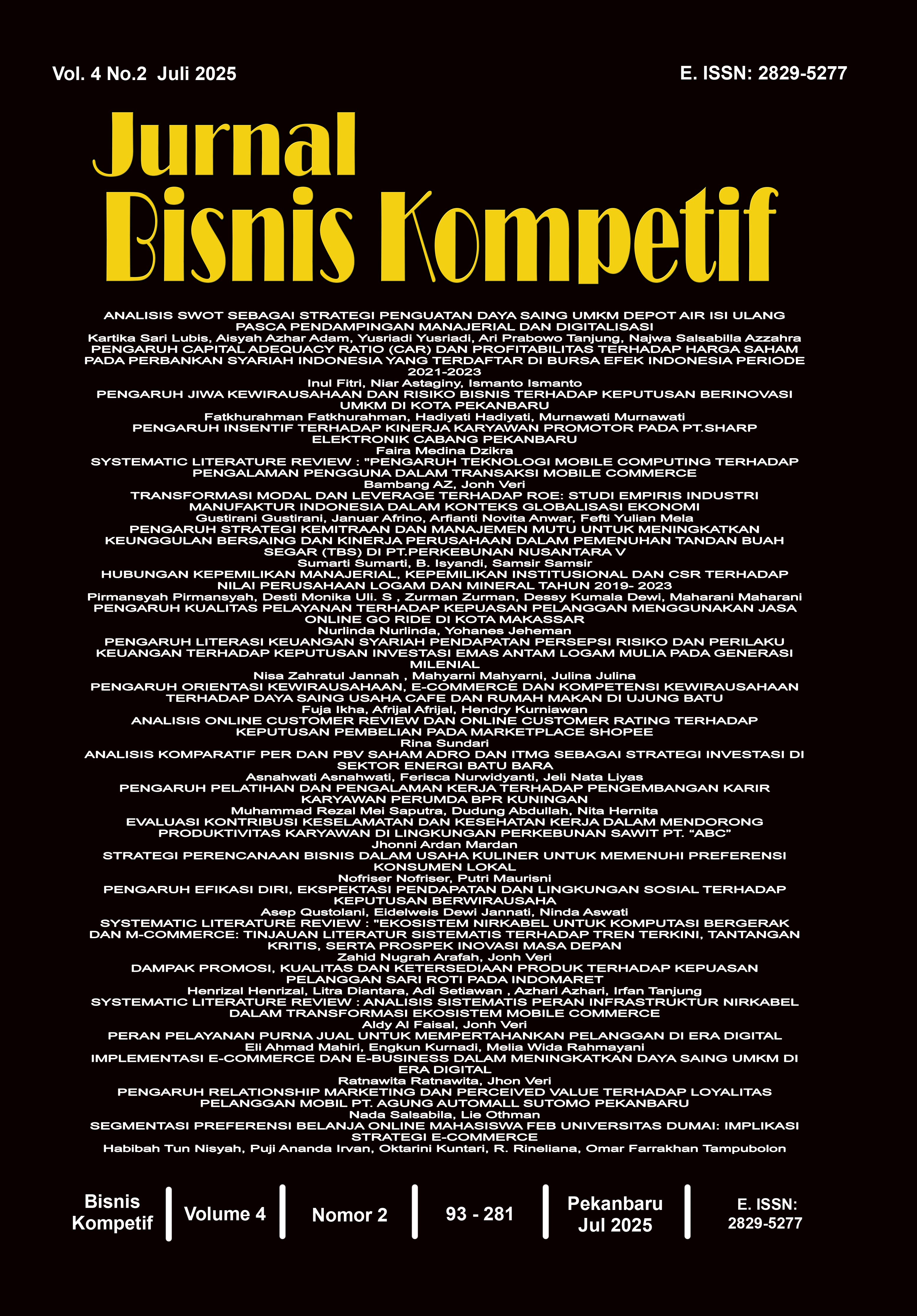
PENGARUH LITERASI KEUANGAN SYARIAH PENDAPATAN PERSEPSI RISIKO DAN PERILAKU KEUANGAN TERHADAP KEPUTUSAN INVESTASI EMAS ANTAM LOGAM MULIA PADA GENERASI MILENIAL
DOI:
https://doi.org/10.35446/bisniskompetif.v4i2.2165Keywords:
Islamic financial literacy, income, risk perception, financial behavior, investment decision, Antam gold, millennial generationAbstract
This study was motivated by the increasing interest of the millennial generation in gold investment, but the low level of Islamic financial literacy and the absence of in-depth empirical studies in Pekanbaru City. The purpose of this study was to analyze the influence of Islamic financial literacy, income, risk perception, and financial behavior on investment decisions for Antam precious metal gold in the millennial generation. This study uses the Theory of Planned Behavior, Decision Theory, and Prospect Theory as theoretical foundations. The method used is a quantitative approach with a survey technique by distributing questionnaires to 100 millennial generation respondents in Pekanbaru City. Data analysis was carried out using validity, reliability tests, classical assumption tests, and multiple linear regression with the help of SPSS version 30. The results of the study showed that partially, income and financial behavior had a positive and significant effect on gold investment decisions, while Islamic financial literacy and risk perception did not have a significant effect. Simultaneously, the four independent variables had a significant effect on investment decisions. These findings indicate that healthy financial behavior and sufficient income levels are dominant factors in driving gold investment decisions. This study provides recommendations for financial institutions and providers of sharia gold products to be more active in educating sharia financial literacy, as well as developing marketing strategies that are adaptive to the preferences of the millennial generation. For academics, this study is expected to be a reference in developing studies on sharia investment and the financial behavior of the younger generation.
References
Afifah, Afifah, and Farid Ardyansyah. (2023) “Analisis Minat Masyarakat Berinvestasi Emas Melalui Produk Pembiayaan Cicil Emas Di Bank Syariah Indonesia Menggunakan Pendekatan Theory of Planned Behavior.” Al-Kharaj : Jurnal Ekonomi, Keuangan & Bisnis Syariah 5, no. 6
Ali, M., and S. Raza. (2023) “Understanding The Impact of Islamic Financial Literacy on Investment Decision-Making Among Millennials.” Journal of Islamic Finance 15, no. 1: 30–45.
Amanda, Bambang Widagdo, and Fika Fitriasari. (2023 “The Effect of Financial Literacy, Personal Income, and Locus of Control in Long-Term Gold Investment Decision.”Jamanika (Jurnal Manajemen Bisnis Dan Kewirausahaan) 3, no. 02): 120–29.
Anggraini Nadea Silvi and Cahyono Edi, (2025) “Pengaruh Sharia Financial Literacy Dan Investment Risk Terhadap Keputusan Investasi Emas Di Pegadaian SyariahDengan Pendapatan Sebagai Variabel Moderating” 14, no. 1: 118.
Andreansyah, Rizki, and Faradila Meirisa. (2022) “Analisis Literasi Keuangan, Pendapatan, Dan Perilaku Keuangan, Terhadap Keputusan Investasi.” Publikasi Riset Mahasiswa Manajemen 4, no. 1: 17–22.
Azizah, US Al, & Mulyono, H. (2020) "Dataset tentang Determinan dan Perilaku Investasi di Kalangan Milenial Muda Indonesia". Data in Brief, 32, 106083.
Buku Pedoman Akademik Pascasarjana UIN Suska Riau, Buku Panduan Penulisan Tesis, (Pekanbaru: UIN Suska Riau, 2023/2024). 112-117
Chairani, Tambunan Irma, and Soemitra Andri.(2023)“Pengaruh Literasi Kuangan, Pendapatan, Dan Gaya Hidup Terhadap Keputusan Investasi Emas Dengan Locus Of Control Sebagai Variabel Moderasi.” Jurnal Akuntasi Dan Pajak 23, no. 02: 1–11.
Chen dan Volpe, An Analysis Of Personal Literacy Among college Students, Financial Services Review. Vol. 7. 2.
Daud, Muhammad, Sudirman Muh. Sajjaj, and Jufri Fahria. (2024) “The Influence of Islamic Financial Literacy on Behavior and Decisions to Invest in Gold Instruments.” Jurnal Ekonomi Dan Bisnis Islam 9, no. 2: 133–48.
Dewan Syariah Nasional Majelis Ulama Indonesia, “Fatwa Dewan Syariah No 77 Tahun 2010 Tentang Jual - Beli Emas Secara Tidak Tunai,” Dewan Syariah Nasional MUI, no. 51 (2010): 1–11, https://dsnmui.or.id/jual-beli-emas-secara-tidak-tunai/.
Diana Djuwita dan Ayus Ahmad Yusuf. (2018) “Tingkat Literasi Keuangan Syariah Di Kalangan UMKM Dan Dampaknya Terhadap Perkembangan Usaha”, Al-Amwal, Vol.10 No.1,.109.
Evanita, Puspitasari Vania, Yetty Fitri, and Nugraheni Siwi. (2021) “Pengaruh Literasi Keuangan Syariah, Persepsi Imbal Hasil, Dan Motivasi Terhadap Minat Investasi Di Pasar Modal Syariah.” Journal of Islamic Economics and Finance Studiess 2, no. 2: 122–41.
Farid Wajdi and others. (2024)Metode Peneltian Kunatitatif, Jurnal Ilmu Pendidikan (Bandung: Widina media Utama, . 2
Fathihani, Susiang Maria Imelda Novita, and Ramadhan Aditya Rian. (2023) “Faktor Yang Mempengaruhi Minat Berinvestasi Emas Digital.” Journal of Fundamental Managemenh 3: 167–79.
Hasan, Muhammad Faraghy, and Dedy Rachmad. (2024) “Pengaruh Literasi Keuangan Syariah Dan Persepsi Risiko Terhadap Minat Investasi Emas Generasi Milenial Muslim Di Jabodetabek.”Postgraduate Journal of Islamic Economic, Finance and Accounting Studies (PJIEFAS) 3, no. 1: 80–100.
Hasanuddin, Ali, and Purwandi Lilik. (2017) “Millenial Nusantara Pahami Karakternya Rebut Simpatinya”. PT Gramedia Pustakan Utama: Jakarta.
Hasanudin, Nurwulandari, A., & Safitri, R. K. (2021). “Pengaruh Pengetahuan Investasi, Motivasi dan Pelatihan Pasar Modal terhadap Keputusan Investasi yang dimediasi oleh Minat Investasi (Studi pada Mahasiswa Universitas Mercu Buana)”. JIMEA | Jurnal Ilmiah.
Hansson, S. O. (2005). "Decision Theory: A Brief Introduction". Royal Institute of Technology.
Heradhyaksa, Bagas. (2022). “Implementasi Investasi Emas Syariah Perspektif Hukum Islam.” Jurnal Hukum Ekonomi Islam (JHEI) 6, no. 1: 35–51.
Hsu Meng-Chiang dan Chiu Chao-Ming, (2004).Predicting Electronic Service Continuance with A Decomposed Theory of Planned Behaviour. Behaviour& Information Technology. Vol. 23, Issue. 5. 359-373.
Hudha, M. Wildan Aghniarrizqi Zarkasyah. (2021). “Pengaruh Literasi Keuangan Syariah Dan Motivasi Terhadap Keputusan Investasi Pada Saham Syariah ( Studi Kasus Mahasiswa Islam.” Jurnal Ilmiah.
Huston, S. J. (2010). "Measuring Financial Literacy". Journal of Consumer Affairs, 44(2), 296–316.
Ilmanna, Nada, Immas Nurhayati, and Renea Shinta Aminda. (2023). “Pengaruh Pendapatan Dan Gaya Hidup Terhadap Minat Investasi Emas DI Kota Bogor.” Jurnal Ekonomi Manajemen Dan Bisnis 2, no. 1: 35–40.
Ina Nur Inayah. (2020). “Prinsip-Prinsip Ekonomi Islam Dalam Investasi Syariah.” Jurnal Ilmu Akuntasi Dan Bisnis 2, no. 2: 2–12.
Indah, Apriani, Majid Nazori, and Rohana. (2023). “Pengaruh Pendapatan , Pengetahuan Dan Kualitas Pelayanan Terhadap Minat Nasabah Menabungan Emas Di Unit Pegadaian Syariah UIN STS Jambi.” Journal of Economics and Bussiness Management 2, no. 1
Irham Fahmi, (2013). "Manajemen Pengambilan Keputusan".Bandung: Alfabeta, , 2.
Irni Rahmayani Johan and Shafa Ariella Azariani, (2025). “Risk Perception , Financial Self-Efficacy , and Interest in Gold Investment among Gen-Z” 18, no. 1: 26–37.
Istan, Muhammad. (2023). “Implementasi Investasi Emas: Kajian Teoritis Dan Praktis Menurut Ekonomi Islam.” Al-Intaj : Jurnal Ekonomi Dan Perbankan Syariah 9, no. 1: 1.
Johan, Irni Rahmayani, and Shafa Ariella Azariani. (2025). “Risk Perception , Financial Self-Efficacy , and Interest in Gold Investment among Gen-Z” 18, no. 1: 26–37.
Junianto, Dwi, Joko Sabtohadi, and Dita Hendriani. (2020). “Persepsi Mahasiswa Muslim Terhadap Investasi Produk Syariah Di Pasar Modal Dalam Kajian Theory Planned Behaviour.” Jurnal Shidqia Nusantara 1, no. 1: 51–60.
Kartini, Kartini, and Katiya Nahda. (2021). “Behavioral Biases on Investment Decision : A Case Study in Indonesia.” Journal of Asian Finance, Economics and Business 8, no. 3 (2021): 1231–40. https://doi.org/10.13106/jafeb..vol8.no3.1231.
Kahneman, Daniel and Amos Tversky. (1979). "Prospect Theory: An Analysis of Decision Under Risk". Econometrica, Vol. 47, No. 2: pp. 263 – 292.
Lusiana, Handayani, Ainun Basyirah, and Fahmi M. Yassir. “The Effect of Islamic Financial Literacy and Financial Inclusion toward Financial Planning among Millennial: Financial Behaviour as an Intervening Variable.” International Journal of Emerging Issues in Islamic Studies 1, no. 2 (2021): 60–67.
Mahyarni. “Theory Of Reasonend Action Dan Theory Of Planned Behavior (Sebuah Kajian Historis Tentang Perilaku).” Jurnal EL-RIYASAH 4 (2013): 13–23.
Majelis Ulama Indonesia, Dewan Syariah Nasional. “Fatwa Dewan Syariah No 77 Tahun 2010 Tentang Jual - Beli Emas Secara Tidak Tunai.” Dewan Syariah Nasional MUI, no. 51 (2010): 1–11. https://dsnmui.or.id/jual-beli-emas-secara-tidak-tunai/.
Mandagie, Yuana Rizky Octaviani, Meriam Febrianti, and Lailah Fujianti. “Analisis Pengaruh Literasi Keuangan, Pengalaman Investasi Dan Toleransi Risiko Terhadap Keputusan Investasi (Studi Kasus Mahasiswa Akuntansi Universitas Pancasila).” Journal Univpancasila 1, no. 1 (2020): 35–47. https://doi.org/10.35814/relevan.v1i1.1814.
Mansur, A, and M Halim. “The Evolving Trends of Islamic Investment Among Millennials: Insights and Implications.” Asian Journal of Islamic Finance 19, no. 1 (2023): 22–38.
Muhammad, Al-Mustafa. “Konsep Investasi Menurut Ekonomi Syariah Di Era Milenial.” Jurlan Ekonomi Syariah Dan Bisnis Islam 02 (2023): 1–2.
Downloads
Published
Versions
- 2025-08-28 (3)
- 2025-08-28 (2)
- 2025-08-28 (1)