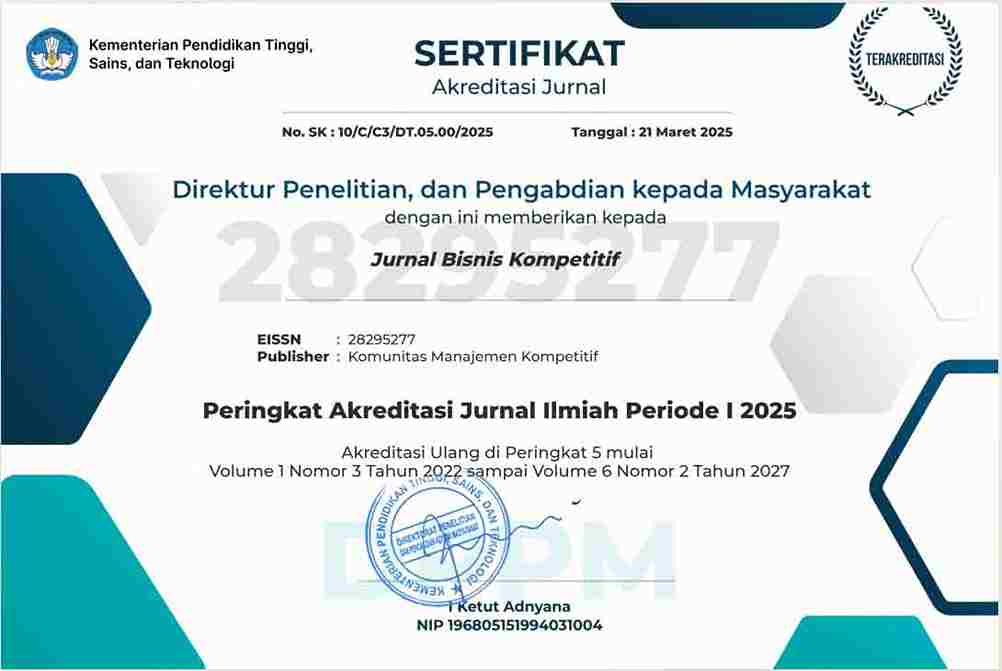
PENGARUH ORIENTASI KEWIRAUSAHAAN DAN BUDAYA ORGANISASI TERHADAP KINERJA UMKM DI KOTA SEMARANG SUBSEKTOR MAKANAN DAN MINUMAN
DOI:
https://doi.org/10.35446/bisniskompetif.v4i3.2537Keywords:
Entrepreneurial Orientation, Organizational Culture, MSME Performance.Abstract
Micro, Small, and Medium Enterprises (MSME) play a strategic role in supporting regional economic growth, including in the City of Semarang. However, increasing market competition and limited resources necessitate that MSMEs develop internal strategies to enhance business performance. This study aims to analyze the influence of Entrepreneurial Orientation and Organizational Culture on the Performance of MSME in Semarang City. A quantitative research approach was employed, with data collected through structured questionnaires distributed to 100 MSME owners and analyzed using Structural Equation Modeling with Partial Least Squares (SEM-PLS). The results indicate that Entrepreneurial Orientation has a positive and significant effect on MSME Performance, meaning that higher levels of innovation, proactiveness, and risk-taking lead to improved business outcomes. Additionally, Organizational Culture also has a positive and significant effect and is found to be the most dominant predictor of MSME Performance. The R-square value of 0.406 shows that both variables collectively explain 40.6% of the variance in MSME Performance. These findings emphasize the importance of strengthening entrepreneurial capabilities and fostering an adaptive organizational culture to enhance competitiveness and business sustainability among MSME.
References
Arabeche, Z., Soudani, A., Brahmi, M., Aldieri, L., Vinci, C. P., & Abdelli, M. E. A. (2022). Entrepreneurial Orientation, Organizational Culture and Business Performance in SMEs: Evidence from Emerging Economy. Sustainability (Switzerland), 14(9), 1–20. https://doi.org/10.3390/su14095160
BPS Kota Semarang. (2025). Profil Industri Mikro dan Kecil Kota Semarang 2023. In BPS Kota Semarang.
Chelliah, M. K., Aravindan, K. L., & Muthaiyah, S. (2022). Entrepreneurial Orientation and Open Innovation Promote the Performance of Services SMEs: The Mediating Role of Cost Leadership. Administrative Sciences, 13(1), 1. https://doi.org/10.3390/admsci13010001
Digdowiseiso, K., & Sugiyanto, E. (2021). How effective is institutional quality for the creation of small & medium enterprises (SMEs) in Indonesia? Economics & Sociology, 14(1), 263–274. https://doi.org/10.14254/2071-789X.2021/14-1/17
Diskopumkm Kota Semarang. (2024). Rencana Kerja (Renja) perubahan Tahun 2024. 1–21.
Dwumah, P., Amaniampong, E.-M., Animwah Kissiedu, J., & Adu Boahen, E. (2024). Association between entrepreneurial orientation and the performance of small and medium enterprises in Ghana: the role of network ties. Cogent Business & Management, 11(1). https://doi.org/10.1080/23311975.2024.2302192
Ferreras-Méndez, J. L., Olmos-Peñuela, J., Salas-Vallina, A., & Alegre, J. (2021). Entrepreneurial orientation and new product development performance in SMEs: The mediating role of business model innovation. Technovation, 108(April), 102325. https://doi.org/10.1016/j.technovation.2021.102325
Gupta, V. K., Niranjan, S., & Markin, E. (2020). Entrepreneurial orientation and firm performance: the mediating role of generative and acquisitive learning through customer relationships. Review of Managerial Science, 14(5), 1123–1147. https://doi.org/10.1007/s11846-019-00327-6
Hair, J., Black, W. C., Babin, B. J., & Anderson, R. E. (2018). Multivariate Data Analysis (Eight Edition). In Gedrag & Organisatie (8th ed., Vol. 8). https://doi.org/10.5117/2006.019.003.007
Hair, Sarstedt, M., Hopkins, L., & G. Kuppelwieser, V. (2014). Partial least squares structural equation modeling (PLS-SEM). European Business Review, 26(2), 106–121. https://doi.org/10.1108/EBR-10-2013-0128
Ikhsan, K., Almahendra, R., & Budiarto, T. (2017). Contextual ambidexterity in SMEs in Indonesia: A study on how it mediates organizational culture and firm performance and how market dynamism influences its role on firm. International Journal of Business and Society, 18(S2), 369–390.
Latan. (2017). Partial Least Squares Path Modeling: Basic Concepts, Methodological Issues and Applications. In Richard Noonan (Ed.), Springer. Springer. https://doi.org/10.1007/978-3-319-64069-3
Lee, Y., & Kreiser, P. M. (2018). Chapter 2 Entrepreneurial Orientation and Ambidexterity: Literature Review, Challenges, and Agenda for Future Research. In Advances in the Study of Entrepreneurship, Innovation, and Economic Growth (Vol. 28, pp. 37–62). https://doi.org/10.1108/S1048-473620180000028002
Mehrez, A. A. Al, Alshurideh, M., Kurdi, B. Al, & Salloum, S. A. (2021). Internal Factors Affect Knowledge Management and Firm Performance: A Systematic Review. In Advances in Intelligent Systems and Computing: Vol. 1261 AISC (pp. 632–643). Springer International Publishing. https://doi.org/10.1007/978-3-030-58669-0_57
Milovanović, B. M., Bubaš, Z., & Mikić, M. (2021). Entrepreneurial Orientation, Strategic Networking, and Croatian SMEs Performance: A Configurational Approach. Business Systems Research Journal, 12(2), 236–252. https://doi.org/10.2478/bsrj-2021-0030
Nofiani, D., Indarti, N., Lukito-Budi, A. S., & Manik, H. F. G. G. (2021). The dynamics between balanced and combined ambidextrous strategies: a paradoxical affair about the effect of entrepreneurial orientation on SMEs’ performance. Journal of Entrepreneurship in Emerging Economies, 13(5), 1262–1286. https://doi.org/10.1108/JEEE-09-2020-0331
Rafiki, A., Nasution, M. D. T. P., Rossanty, Y., & Sari, P. B. (2023). Organizational learning, entrepreneurial orientation and personal values towards SMEs’ growth in Indonesia. Journal of Science and Technology Policy Management, 14(1), 181–212. https://doi.org/10.1108/JSTPM-03-2020-0059
Sabaruddin, S., Astuti, E. S., Arifin, Z., & Iqbal, M. (2024). Does Organizational Culture Influence IT-Business Alignment and Business Performance in Large Manufacturing Companies? KnE Social Sciences, 2024, 336–367. https://doi.org/10.18502/kss.v9i11.15806
Schein, E. H. (1992). How Can Organizations Learn Faster? The Problem Of Entering The Green Room. Japanese Society of Biofeedback Research, 19, 709–715. https://doi.org/10.20595/jjbf.19.0_3
Wei, Y. (Susan), Samiee, S., & Lee, R. P. (2014). The influence of organic organizational cultures, market responsiveness, and product strategy on firm performance in an emerging market. Journal of the Academy of Marketing Science, 42(1), 49–70. https://doi.org/10.1007/s11747-013-0337-6
Zhao, H., Teng, H., & Wu, Q. (2018). The effect of corporate culture on firm performance: Evidence from China. China Journal of Accounting Research, 11(1), 1–19. https://doi.org/10.1016/j.cjar.2018.01.003
Downloads
Published
Versions
- 2025-12-17 (2)
- 2025-12-17 (1)